

Competences & Products
Automation
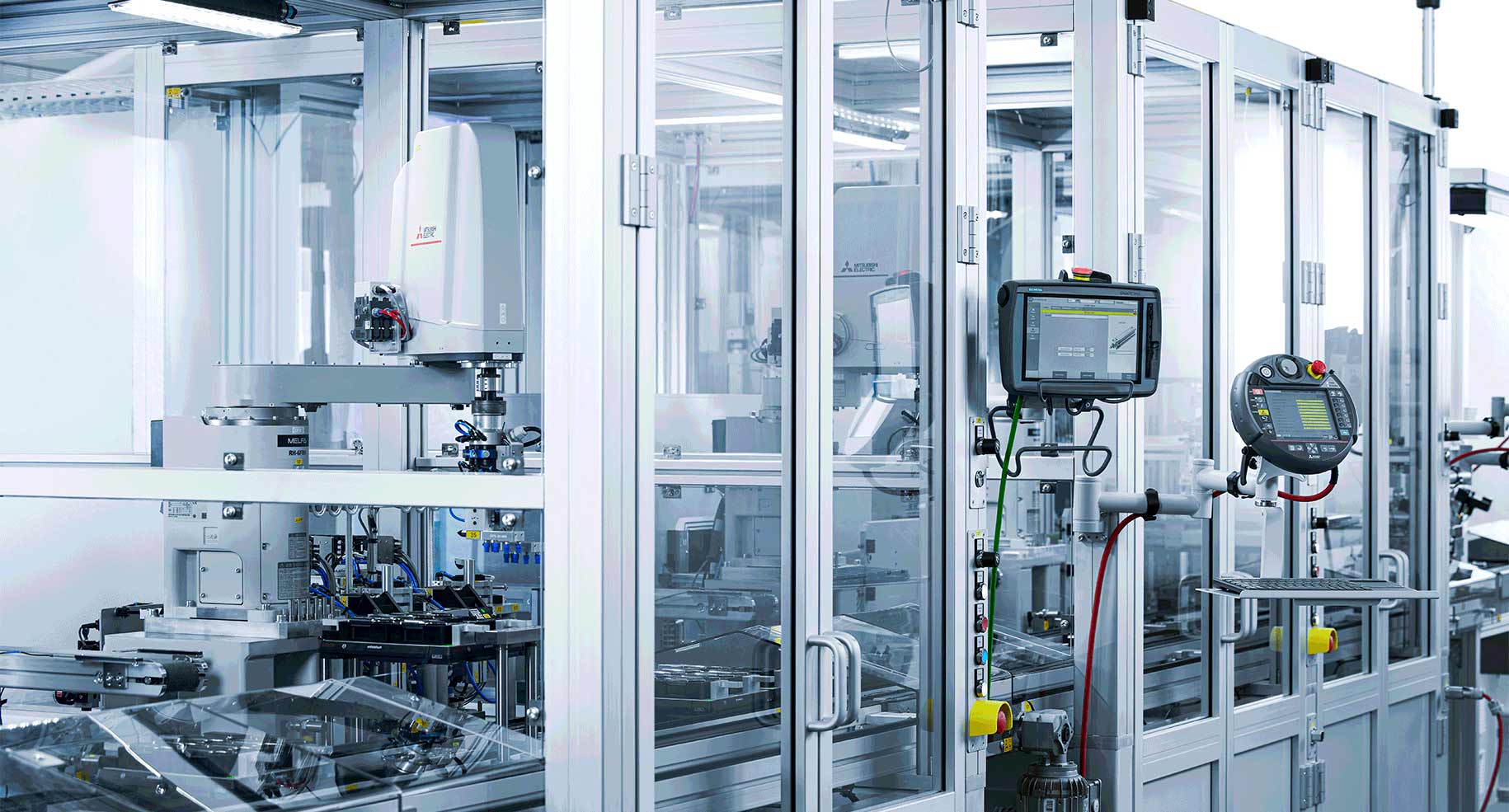
Our automation solutions enable the seamless linking of manufacturing processes, from feeding to packaging, ensuring efficient and coordinated production. At the same time, all systems are based on sophisticated test technology, which is our core competence.
Depending on requirements, the systems can be implemented as manual workstations, rotary indexing tables, linked cells, or complete inline production systems – as a supplier of turnkey assembly systems, we offer the integration of robotics, feeding systems and inspection technology. All workstations are designed to be ergonomic and safe.
High-quality sensor technology ensures 100% process control, while all relevant data is recorded and integrated into workflow and MES systems, thus enabling full traceability.


Competences
Manual process module


Equipment for manual operation
The system with manual insertion area enables the integration of diverse processes.
Semi-automatic process module
Manual operation combined with automated processes
Components with a scalable degree of automation guarantee flexible production figures.
Fully automatic process module
Fully automated assembly lines for maximum efficiency and reliability
Various processes from feeding to AOI can be linked and designed as a fully automatic line.
Feeding
Intelligent feeding systems for reliable and efficient part supply
Benefit from safe and stable feeding through high autonomy – with ENGMATEC feeding systems.
Whether manual insertion or automated feeding, whether ordered in a defined transport container or as bulk material – we develop and integrate various feeding systems for the needs-based feeding of system components.
Spiral conveyors, tray handlers, and other flexible solutions are possible. Our efficient systems reduce your employees’ workload and thus your costs.
Handling and transport
Automated handling systems for precise material flow and Transport
Reduce production costs significantly – with the automation of various handling steps. For this purpose, ENGMATEC develops and integrates intelligent handling systems for PCBs and assemblies. Whether a goods carrier circulation system, rotary indexing table, robot handling, or axis and gripper systems are used depends on your customer-specific requirements.
Due to its high reliability and short cycle times, an investment in process automation quickly pays for itself.
Joining, positioning, and assembly
Precision assembly processes for joining, positioning, and fastening components
ENGMATEC assembles your product along with the necessary processes. Be it press-fitting (with or without force-displacement monitoring), screwing or gluing: together we will define the required processes. To ensure process quality, we can define the limits of the process parameters for each case, thereby minimizing failure rates.
We also label your product to ensure it remains traceable.
Testing
Integrated testing solutions for maximum product quality and safety
And to give you the certainty that your product has been assembled correctly, we integrate an end-of-line tester right into the assembly system. This encompasses both electrical and mechanical tests, e.g. haptic tests.
Special tests, such as leakage or high-frequency tests, demonstrate ENGMATEC’s testing expertise, as do visual checks. For you, this means added security – for you and your product.
Integration with traceability systems
End-to-end traceability through smart system integration
When was which part assembled? What were the process parameters? What was the result of the end-of-line test?
To ensure that you can track all the production steps for your products at any time and get an overview of them later on, we offer you the necessary integration into your traceability system.
Our experts will tailor the different products to your individual needs.
FAQ Automation Solutions
How long does it take to implement an automated production line?
The project duration depends on the complexity and level of customisation. Standard solutions are usually implemented within 6 to 9 months, whilst complex systems require 12 to 18 months. In addition to a clear concept at the start of the project, precise integration into existing IT structures and compliance with communication standards such as OPC UA are crucial. A time buffer of 15 to 20 per cent is recommended to allow for unexpected delays.
How can automated assembly remain flexible in the case of changing product requirements?
The flexibility of automated assembly is achieved through modular design and adaptable feeding systems. Quick-change tools and configurable software are essential for producing different variants with minimal changeover effort. Scalable architectures and standardised interfaces ensure the system’s expandability.
How long does it take for an investment in automation technology to break even for medium-sized businesses?
For medium-sized companies, the payback period for an investment in automation is usually between two and five years. Key factors include efficiency gains of around 20 to 30 per cent, as well as reductions in waste and labour costs. A detailed cost-benefit analysis should be carried out in advance to determine a realistic return on investment.
The total cost of ownership should also be taken into account.
What are the key factors that influence the total cost of ownership (TCO) of an assembly line?
The TCO of an assembly line includes not only the initial purchase cost but also expenditure on energy, maintenance, software licences and staff training. Annual operating costs, in particularly, which usually amount to 15 to 20 per cent of the initial investment, have a significant impact on the total cost. A comprehensive life-cycle analysis is required to accurately forecast the actual costs and optimise them in the long term.
What training costs will be necessary for employees to use a new system after it has been set up?
Once a system is put into operation, a structured training programme is required for all staff groups. Operators typically need a one- to three-day induction, whilst maintenance staff require three to five days to learn the maintenance procedures. Integrating this training into the project plan at an early stage is crucial for safe and efficient operation.
How much floor space do typical automated assembly lines require?
The space required depends on the level of automation and the complexity of the process. Single assembly stations usually take up 10 to 20 square metres, whilst fully automated in-line systems require over 100 square metres. A compact system design and an efficient material flow are essential. Precise layout planning helps to determine the actual space required.
What safety regulations must be observed when operating assembly lines?
Assembly lines are subject to the Machinery Directive 2006/42/EC and the DIN EN ISO 12100 standard on risk assessment. These require the systematic identification and minimisation of dangers. The CE label confirms compliance with all EU directives. Regular reviews of the risk assessment and updates to the declaration of conformity are required.
Your advantages
Assembly and testing expertise from a single source
Custom solutions
Economical concepts
Minimization of production errors
Savings through reduced manpower requirement
Transparency in the production process

Do you have individual requirements?
We will find the right solution.
From process analysis to the finished system.
